Typology
Undergraduate Academic Work | Kevin M. Welch, AIA
Henderson Civic Memorial Garden + City Hall
Conceived during a third-year spring architecture studio, this proposal for Henderson City Hall begins with the material that helped shape the city’s history: magnesium.
Henderson was incorporated in 1953, following the end of World War II and the closure of the Basic Magnesium manufacturing plant. During the war, the plant produced magnesium ingots used in metal alloys for aircraft components, artillery, and other military applications. Its production supported the national war effort while laying the economic and civic foundations for the city that followed.
Rather than treating this history as a static artifact, the project translates it into architecture, landscape, and movement. The trapezoidal cross section of a magnesium ingot provides the design’s primary geometry. When two ingots are joined along their bases, they form a hexagon—a shape that becomes both a symbolic reference and an organizing system for the site.
Within the memorial garden, this hexagonal grid is transformed into a field of elevated landforms. The forms appear to rise from the earth before separating along fractured edges, creating narrow pathways between dark, inscribed walls. The names of service members are encountered gradually along these passages, allowing remembrance to unfold through movement rather than from a single fixed viewpoint.
The approach rises gently into the memorial, slowly revealing its interior paths. Above, a dense canopy of white-leafed trees gathers across the elevated forms like a luminous blanket. Their softness tempers the weight of the walls below, creating a sheltered landscape defined by filtered light, shifting shadows, and moments of quiet reflection. The memorial becomes less an isolated monument than an immersive environment—one that asks visitors to move, pause, and remember.
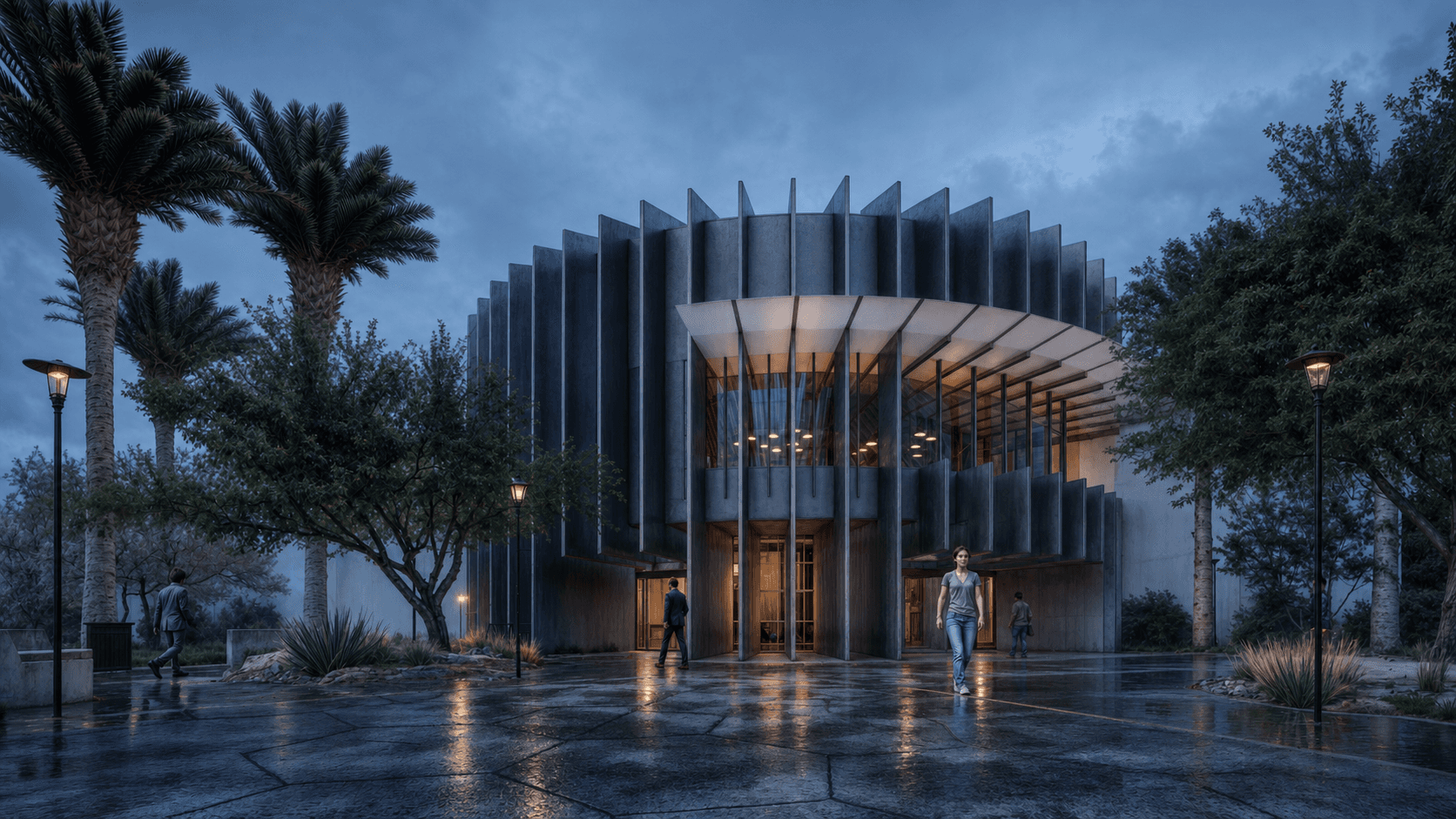
Adjacent to the garden, a new entrance addition reimagines the arrival sequence to Henderson City Hall. Its radial form draws inspiration from an aircraft-engine impeller, another component historically produced from magnesium alloys. Just as an impeller collects and directs airflow to generate forward movement, the entrance gathers visitors from the surrounding landscape and distributes them into the civic building.
The metaphor extends beyond the object itself. An impeller is composed of individual elements working together as an essential part of a larger system—a relationship that reflects the formation of a city and the shared civic structure that sustains it. Here, the architecture becomes both threshold and instrument: monumental enough to establish a public identity, yet open enough to invite participation.
Across the larger site, the hexagonal network expands toward Water Street and neighboring civic venues. It organizes gardens, gathering spaces, circulation routes, and areas for public activity while encouraging movement and interaction between them. Solemn spaces of remembrance are placed in dialogue with the everyday life of the city.
The proposal ultimately considers memory and civic engagement as connected acts. Through the transformation of Henderson’s industrial history into landscape and form, the project creates a place where sacrifice is honored, community is gathered, and the city’s past becomes a foundation for its continued public life.