Typology
Undergraduate Academic Work | Kevin M. Welch, AIA
A Tea House Shaped by Passage
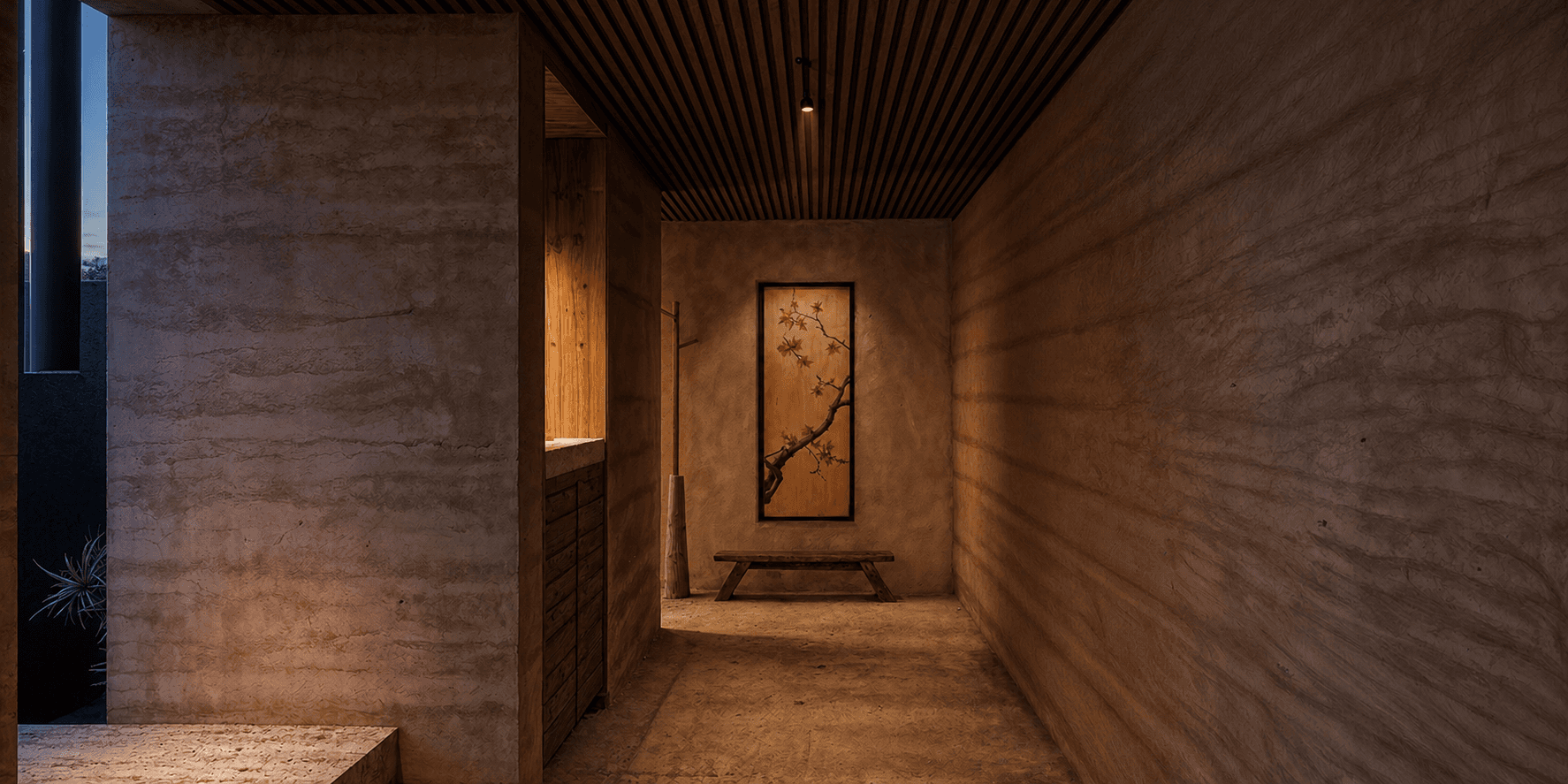
The ritual of tea begins long before the first cup is poured. Developed during a third-year fall architecture studio at the UNLV School of Architecture, Desert Roji reinterprets the traditional Japanese roji and tea house as an immersive desert landscape—one designed to gradually separate visitors from the familiarity and distraction of everyday life.
Rather than reproducing the appearance of traditional Japanese architecture, the project draws from its underlying spatial principles: procession, restraint, asymmetry, purification, and the expressive potential of emptiness. Architecture and landscape work together to prepare the visitor for the tea ceremony, transforming arrival into a carefully choreographed passage between two states of mind.
The experience begins at a compressed entry portal. Its narrowing geometry reduces the visitor’s field of vision and establishes an immediate sense of separation from the world beyond. From this threshold, a garden path folds through the site between a desert interpretation of a Zen garden and a series of framed views toward the northern landscape. Irregular stepping stones, raked ground, water, vegetation, and shifting walls encourage a slower, more deliberate pace.
The path is conceived not simply as circulation, but as a sequence of adjustments. Views appear and disappear. Spaces contract before opening again. Changes in elevation, texture, shadow, and enclosure continually reorient the body, allowing the rhythms of the site to replace those of the outside world.
Midway through the procession, visitors arrive at the machiai, a sheltered place for waiting and quiet reflection. Here, movement pauses. The architecture frames the garden without revealing the tea house completely, preserving a sense of anticipation. Once invited to continue, guests proceed to a stone water basin, where the traditional act of cleansing becomes another moment of physical and psychological preparation.
Beyond the basin, an opening in the earth receives the visitor in a protective, almost geological embrace. The path descends between enclosing planes, exchanging the broad desert horizon for a more intimate world of shadow, water, and filtered light. At the center of this lowered landscape, the tea house is gradually revealed as a dark, elemental volume resting within a koi pond.
The tea house itself is deliberately simple. Its compact interior is organized around the proportions of four and a half tatami mats, accommodating a small gathering of no more than five people. A low entrance requires each guest to bow while entering, making humility an architectural act shared equally by everyone who crosses the threshold.
Inside, light is carefully rationed. Narrow incisions cut through the walls and sloping roof, admitting measured shafts of illumination while limiting direct views of the exterior. Where these openings intersect, they mark the position of the tea room from different points within the garden. The building becomes both concealed and quietly legible—a destination perceived through fragments rather than announced all at once.
A sunken hearth, separate host entrance, preparation area, and restrained display alcove support the ceremony without overwhelming it. Ornament is reduced to what is necessary for the moment: a scroll, a flower, the tea utensils, and the changing quality of light. The room’s asymmetry and deliberate incompleteness leave space for the imagination, allowing the ceremony and its participants to complete the architecture.
Following the gathering, the procession reverses its inward movement. Visitors leave the tea house, pass once more through the enclosing landscape, and ascend toward a final place of reflection. From there, the path leads gradually back to the outside world.
Created within the exploratory setting of the UNLV School of Architecture, the project ultimately understands architecture as a transition rather than an object. Through compression and release, concealment and revelation, descent and ascent, Desert Roji creates a place in which ordinary perception is slowed and renewed. The tea house is not merely the destination at the center of the garden; it is the still point within a larger journey—one shaped by silence, ritual, and the passage from familiarity into reflection.