Residential Work
Accreted House
Residential Work
Accreted House
Quiet Assembly
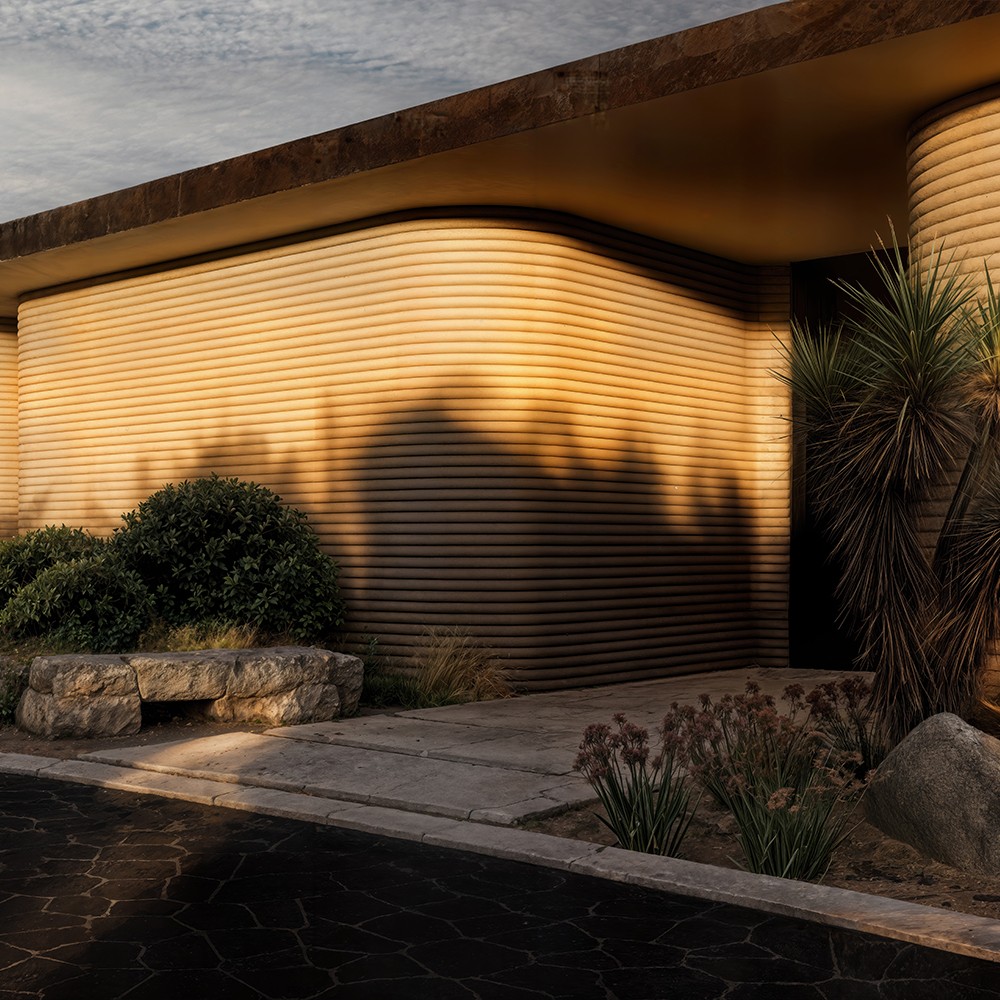
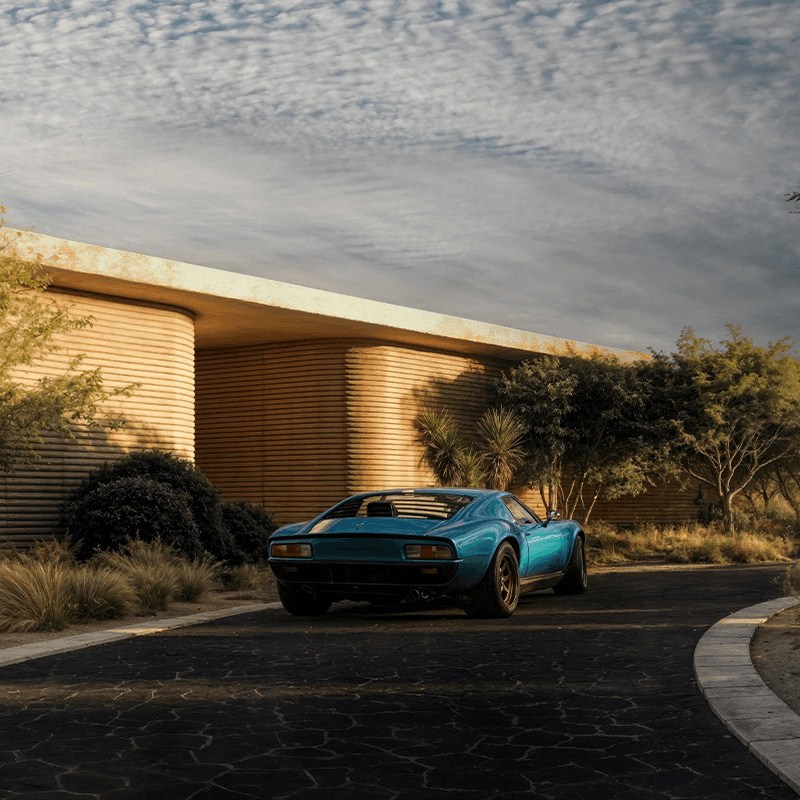
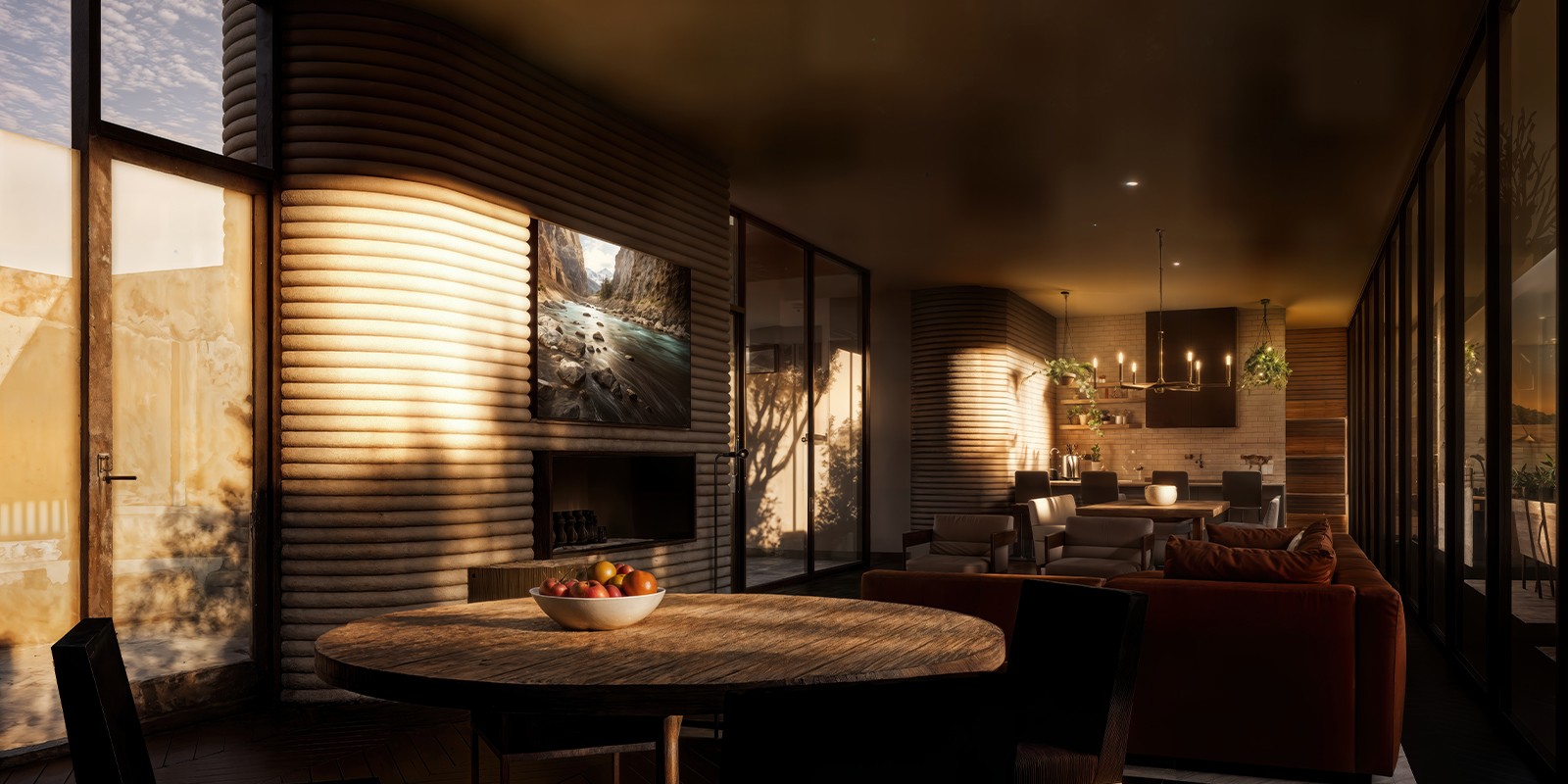
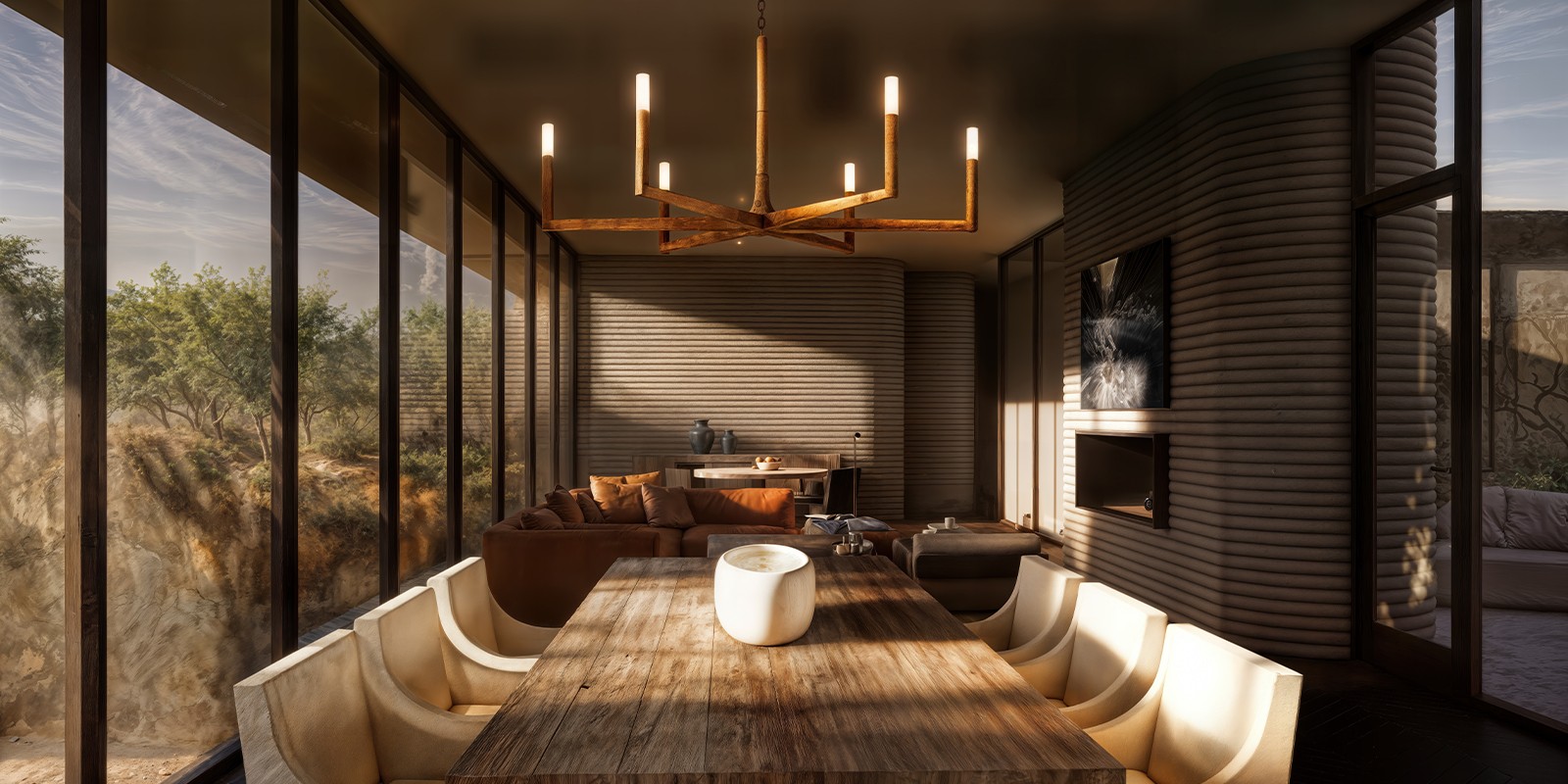
Set low against the desert horizon, the house reads first as a continuous, disciplined line held lightly against the landscape. Its mass is shaped not by walls in the traditional sense, but by softly rounded, printed volumes that glide past one another with quiet control. The architecture resists spectacle in favor of composure. Light is filtered rather than framed. Shadow is allowed to linger. The building feels grown rather than placed, as if drawn upward from the ground itself through pressure, time, and repetition.
Habitable Machine
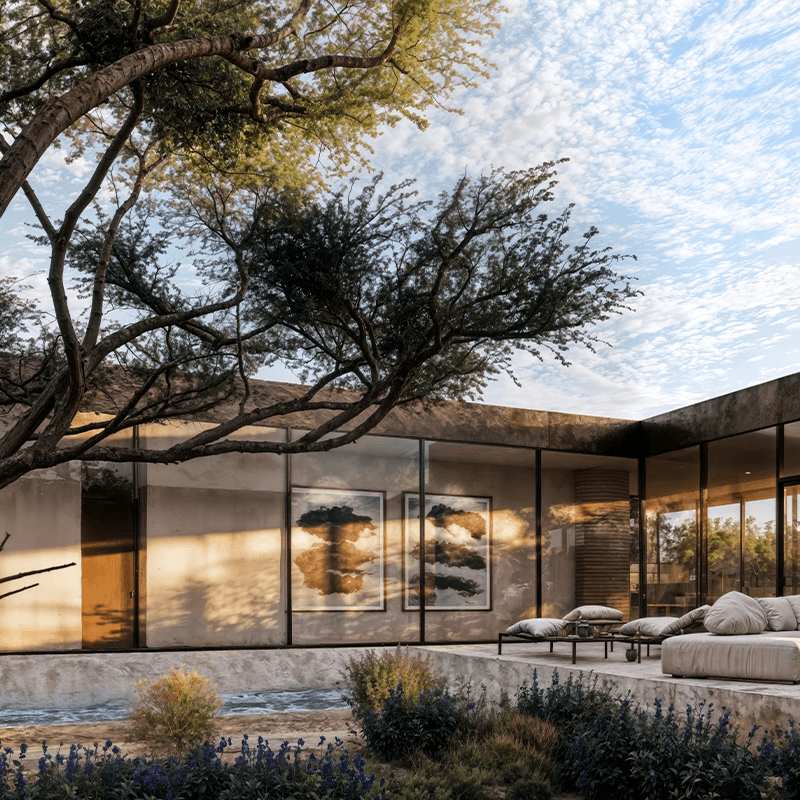
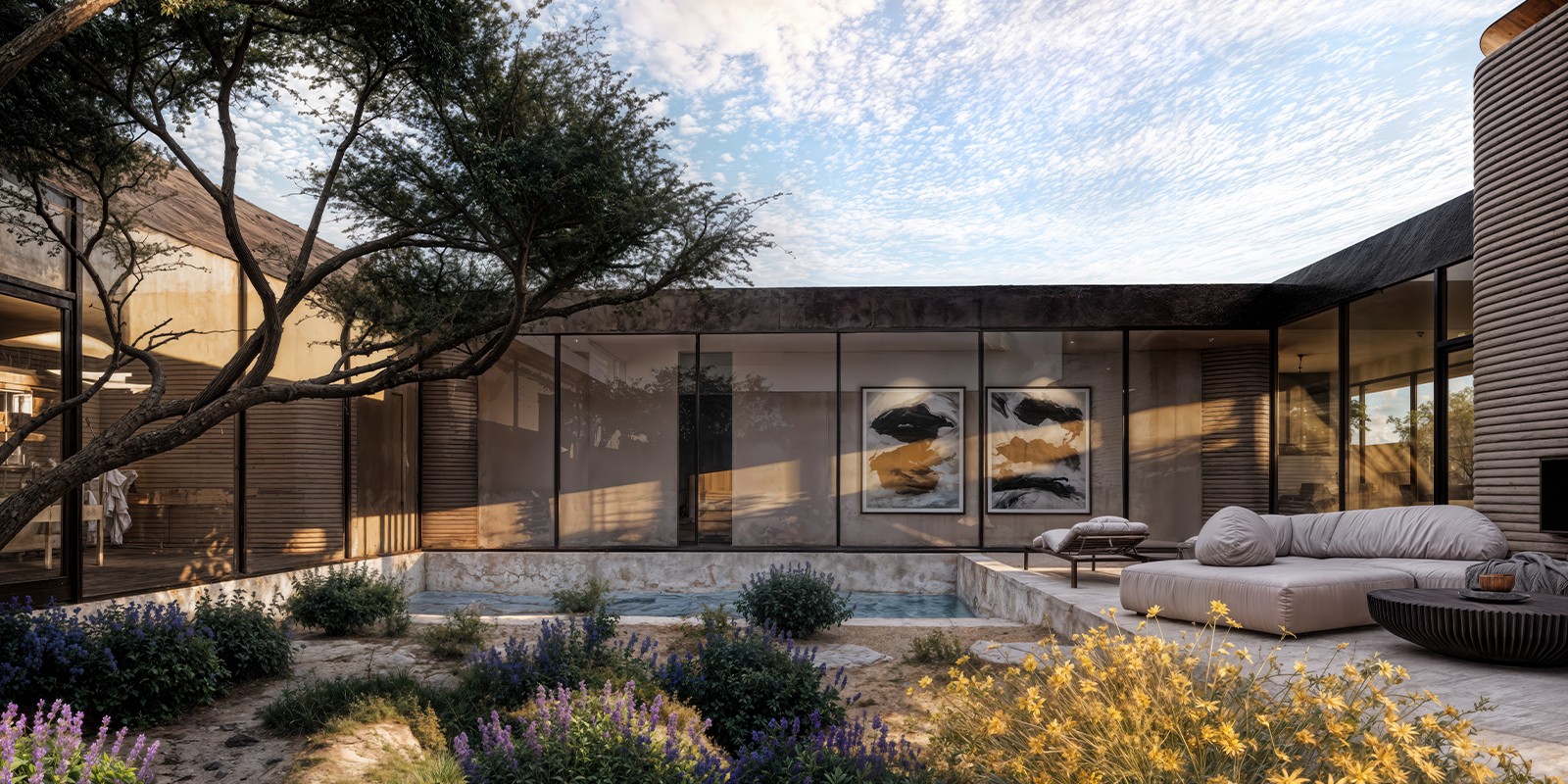
At the center of the plan, a protected courtyard becomes the true heart of the dwelling. Living spaces unfold inward toward water, tree canopy, and open sky, dissolving the boundary between interior and exterior through glass, reflection, and compression. The curved printed walls guide movement gently, shaping rooms without ever enclosing them harshly. Furnishings, light, and circulation operate as extensions of the architectural logic rather than overlays upon it. What emerges is a house that behaves like an instrument, tuned to atmosphere, intimacy, and daily ritual.
Fabricated Landscape
More than a residence, the project operates as a continuous negotiation between technology and ground. Additive construction is not presented as an aesthetic stamp, but as a tectonic process that reshapes how enclosure, structure, and surface become one. The printed walls do not hide their making. They reveal it as texture, rhythm, and form. Landscape and architecture interlock as a single system where desert planting, stone, shadow, and wall surface merge into a unified field. The house becomes neither object nor shelter alone, but a constructed terrain for living.
“This house does not celebrate technology as novelty, but as quiet inevitability, transforming additive construction into an architecture of calm, weight, and inhabited silence.”
Kevin M. Welch, AIA
Architect + Founder | Arcturus
Quiet Assembly
Set low against the desert horizon, the house reads first as a continuous, disciplined line held lightly against the landscape. Its mass is shaped not by walls in the traditional sense, but by softly rounded, printed volumes that glide past one another with quiet control. The architecture resists spectacle in favor of composure. Light is filtered rather than framed. Shadow is allowed to linger. The building feels grown rather than placed, as if drawn upward from the ground itself through pressure, time, and repetition.
Residential Work
Accreted House
Quiet Assembly
Set low against the desert horizon, the house reads first as a continuous, disciplined line held lightly against the landscape. Its mass is shaped not by walls in the traditional sense, but by softly rounded, printed volumes that glide past one another with quiet control. The architecture resists spectacle in favor of composure. Light is filtered rather than framed. Shadow is allowed to linger. The building feels grown rather than placed, as if drawn upward from the ground itself through pressure, time, and repetition.
Habitable Machine
At the center of the plan, a protected courtyard becomes the true heart of the dwelling. Living spaces unfold inward toward water, tree canopy, and open sky, dissolving the boundary between interior and exterior through glass, reflection, and compression. The curved printed walls guide movement gently, shaping rooms without ever enclosing them harshly. Furnishings, light, and circulation operate as extensions of the architectural logic rather than overlays upon it. What emerges is a house that behaves like an instrument, tuned to atmosphere, intimacy, and daily ritual.
Fabricated Landscape
More than a residence, the project operates as a continuous negotiation between technology and ground. Additive construction is not presented as an aesthetic stamp, but as a tectonic process that reshapes how enclosure, structure, and surface become one. The printed walls do not hide their making. They reveal it as texture, rhythm, and form. Landscape and architecture interlock as a single system where desert planting, stone, shadow, and wall surface merge into a unified field. The house becomes neither object nor shelter alone, but a constructed terrain for living.
“This house does not celebrate technology as novelty, but as quiet inevitability, transforming additive construction into an architecture of calm, weight, and inhabited silence.”
Kevin M. Welch, AIA
Architect + Founder | Arcturus
Habitable Machine
At the center of the plan, a protected courtyard becomes the true heart of the dwelling. Living spaces unfold inward toward water, tree canopy, and open sky, dissolving the boundary between interior and exterior through glass, reflection, and compression. The curved printed walls guide movement gently, shaping rooms without ever enclosing them harshly. Furnishings, light, and circulation operate as extensions of the architectural logic rather than overlays upon it. What emerges is a house that behaves like an instrument, tuned to atmosphere, intimacy, and daily ritual.
Fabricated Landscape
More than a residence, the project operates as a continuous negotiation between technology and ground. Additive construction is not presented as an aesthetic stamp, but as a tectonic process that reshapes how enclosure, structure, and surface become one. The printed walls do not hide their making. They reveal it as texture, rhythm, and form. Landscape and architecture interlock as a single system where desert planting, stone, shadow, and wall surface merge into a unified field. The house becomes neither object nor shelter alone, but a constructed terrain for living.
“This house does not celebrate technology as novelty, but as quiet inevitability, transforming additive construction into an architecture of calm, weight, and inhabited silence.”
Kevin M. Welch, AIA
Architect + Founder | Arcturus